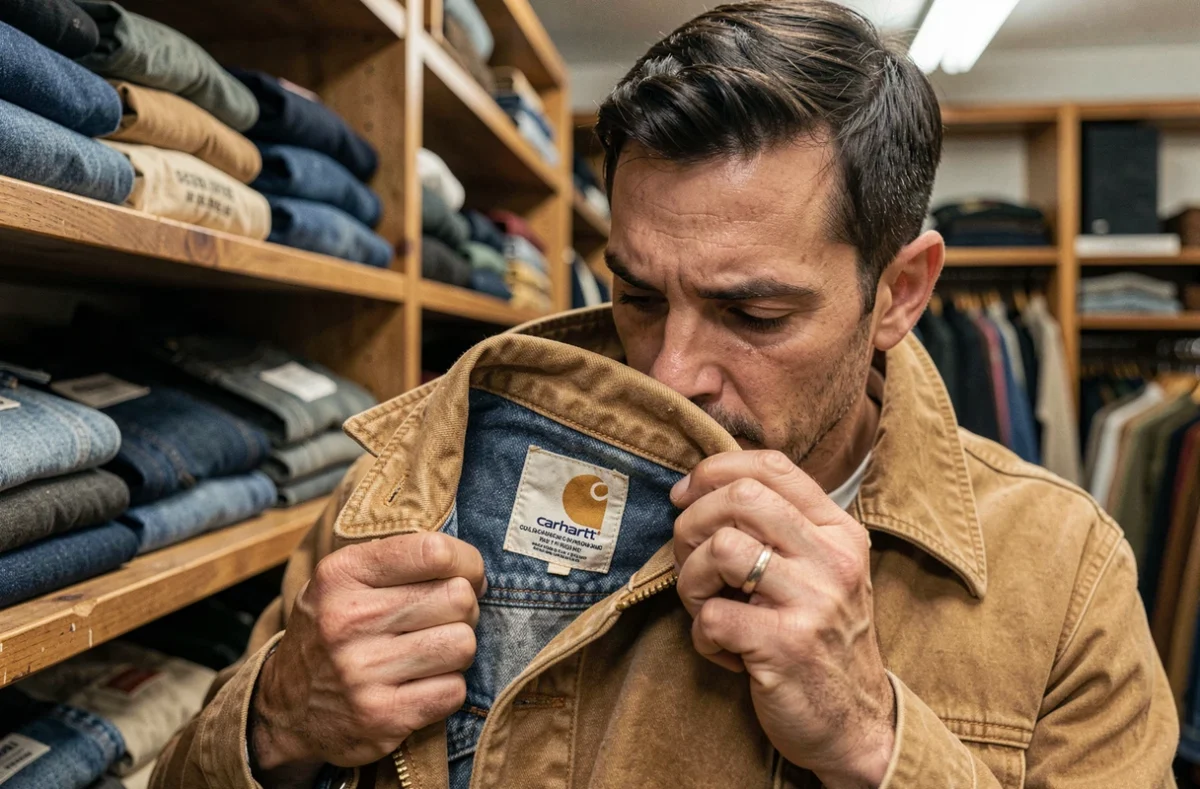
An authentic Carhartt garment is recognized by a set of manufacturing details, not by a single isolated criterion. Embroidered logo, internal labels, reinforced seams, engraved hardware: each element must be consistent with the line (Carhartt Inc. or Carhartt WIP) and the production period. Checking just one point is never enough to draw a conclusion.
Carhartt Inc. and Carhartt WIP: two lines, two labeling systems
Before examining a garment, it is essential to know which entity it belongs to. Carhartt Inc. is the American workwear brand, founded in Detroit in 1889. Carhartt WIP (Work In Progress) is the European offshoot of the brand, which produces streetwear reinterpretations of Carhartt silhouettes.
Both are legitimate, but their labels, cuts, style codes, and manufacturing methods differ. Counterfeiters often mix labeling elements from both lines on a single fake garment. This is, in fact, the most reliable macro indicator of a counterfeit: a piece that bears a WIP logo (square) with a size label in American format (W x L) has no reason to exist.
Carhartt Inc. sizes follow the American system (S, M, L or measurements in inches). Carhartt WIP uses a European system. An item whose size format does not match the displayed line deserves a thorough check, especially by consulting the Chercher site for authentic Carhartt quality which details these differences.

Embroidered logo and engraved buttons: the first elements to inspect
The Carhartt logo, the famous “C” in an arch shape, is always embroidered on authentic pieces. On a counterfeit, it is often simply printed, and this print tends to peel off after washing. A neat embroidered “C” logo, with regular threads, is a positive first signal.
The hardware provides a second level of verification. The metal buttons on a genuine Carhartt bear the engraving “Carhartt” in relief. On fakes, this inscription is either absent or crudely printed on the surface. Zippers follow the same logic: they must be industrial quality, with a smooth pull and no snags.
Quick visual check points
- The embroidered “C” has sharp edges and consistent spacing between the threads, with no smudges or loose threads
- The snap buttons and rivets are engraved “Carhartt” in relief, not just marked on the surface
- The color known as “Carhartt Brown” (a deep ochre specific to the brand) is difficult to reproduce accurately on counterfeits, which often lean towards a duller or more orange-brown
Internal label and holographic tape: in-depth verification
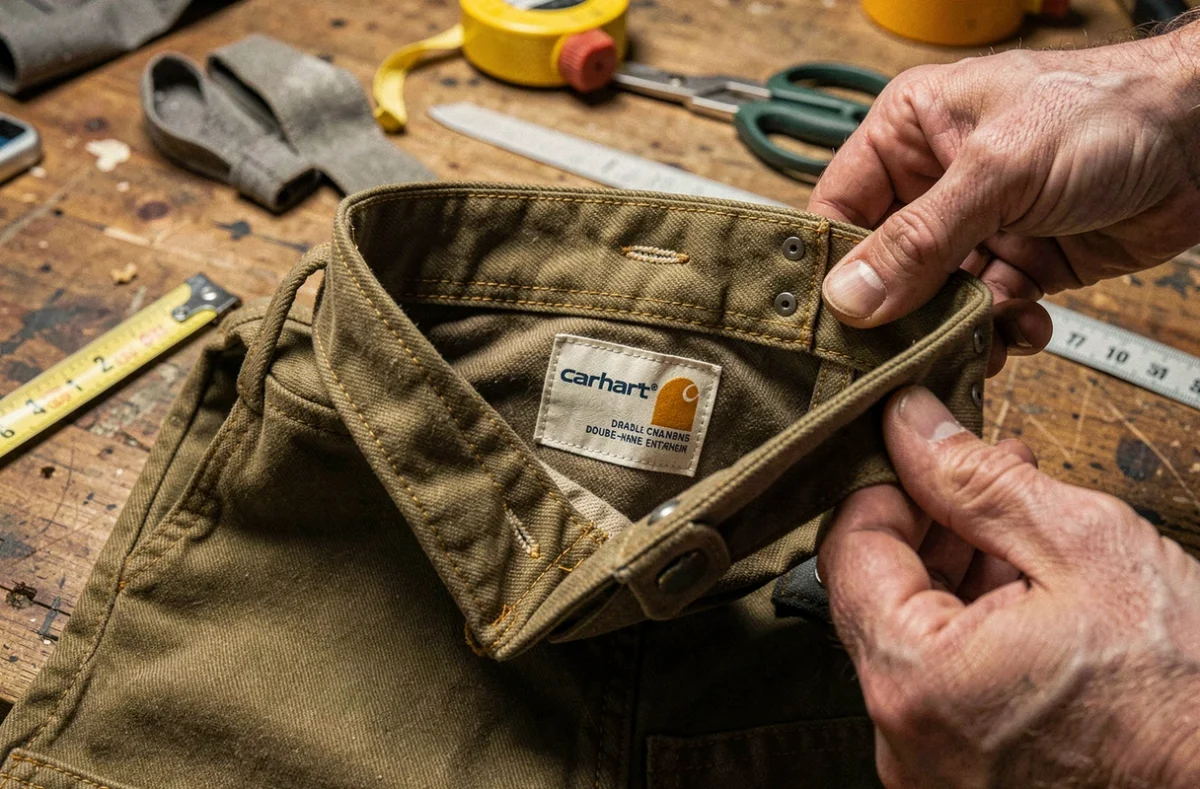
The collar label and care (or washing) label are the heart of authentication. On recent Carhartt pieces, the internal label includes a style number (model code) consistent with the official catalog. This number allows for cross-referencing the model, color, and cut advertised.
Contemporary Carhartt items often incorporate a holographic tape on the care label. This tape changes reflection depending on the viewing angle and remains difficult for counterfeiters to reproduce. Its absence does not automatically mean the piece is fake: it depends on the age of the garment and the model. Vintage pieces do not have it.
For a second-hand purchase, asking for clear photos of the collar label, care label, seams, and zipper is a basic reflex. A seller who refuses to provide these images gives a reason for caution, even if it does not prove a counterfeit by itself.
Seams and textile construction: what the finish reveals
Authentic Carhartt garments use double or triple stitching at stress points (armholes, pockets, inseams). These reinforcements are characteristic of industrial workwear and aim for a durability that counterfeits do not seek to achieve.
On a fake, the seams are generally single, with a thinner thread and irregular stitches. The topstitching on a genuine Carhartt forms straight and parallel lines, with consistent spacing between each stitch. An examination in low-angle light is enough to spot suspicious waviness.
Common pitfalls on vintage jackets
On an old jacket, an absent or very worn label is not enough to declare the piece fake. Dating a vintage Carhartt relies on combined clues: label style, model code, type of closure, and construction details. The label alone does not always provide an accurate date.
Similarly, the country of manufacture is not a test of authenticity by itself. Carhartt has produced in various countries depending on the era and ranges. A “Made in Mexico” or “Made in China” on a Carhartt piece means nothing without cross-referencing with the relevant model.
Carhartt authentication checklist before purchase
- Identify the line (Carhartt Inc. or WIP) and ensure all labeling elements correspond to that line, with no mixing
- Inspect the embroidered logo, engraved buttons, and zippers for their finishing quality
- Check the style number on the internal label and compare it to the brand’s catalog
- Examine the seams at stress points: double or triple, thick thread, straight and regular lines
- Verify the possible presence of a holographic tape on the care label, considering the age of the piece
Authenticating a Carhartt relies on cross-referencing multiple clues, never on a single criterion. A piece whose logo, labels, seams, and hardware are all consistent with each other offers a strong body of evidence. Doubt remains when just one of these elements stands out compared to the others.