
Every year, families gather around a Christmas meal. Is this meal a tradition or a custom? The answer depends on what we observe: the gesture repeated mechanically or the meaning passed down from generation to generation. Custom and tradition refer to two ways in which a community preserves its practices, but they do not function in the same way.
What separates the gesture from the narrative in a cultural practice
Let’s take a simple example. In several French regions, people give lily of the valley on May 1st. Most people do this out of habit, without questioning why. This collectively repeated gesture, embedded in daily life without the need for explanation, corresponds to a custom.
Now, imagine a family passing down to its children the story of this practice, recounting its origins and associating it with values of solidarity. The same gesture then becomes a tradition because it carries a narrative and an intention of transmission.
A custom is a repeated collective behavior, while tradition adds a meaning that is voluntarily transmitted. Understanding the difference between custom and tradition involves distinguishing “we do it this way” from “we do it this way because.”
A custom can exist without anyone knowing why it exists. It is maintained through social imitation. A tradition, on the other hand, requires an effort of memory: someone tells, teaches, or transmits the historical or symbolic context of the practice.

Local custom and cultural tradition: the role of the community
Have you ever noticed that some practices never go beyond the borders of a village or a region? Customs are often local. They arise from a specific geographical, climatic, or economic context.
In Alsace, the tradition of Christmas markets is accompanied by customs specific to each municipality: a particular dish, a specific decoration, a mass schedule. These customs vary from one place to another. Tradition, however, encompasses a broader set and fosters a regional or even national cultural identity.
How a custom becomes a tradition
The transition from one to the other is not automatic. A custom becomes a tradition when a community decides to give it meaning and to transmit it. This process takes time, sometimes several generations.
Take the galette des Rois. Initially, sharing a cake in January was a custom linked to the agricultural calendar. Gradually, religious and family narratives were added. The practice acquired a symbolic dimension that goes beyond the simple act of eating together.
The opposite can also happen. A tradition can reduce to a custom if its founding narrative is lost. When no one knows why something is done, the practice survives as a habit but loses its cultural significance.
Concrete criteria for distinguishing custom and tradition
Rather than an abstract definition, here are the operational criteria that allow for the classification of a practice:
- Presence of a founding narrative: tradition relies on a story, a myth, or a historical event. A custom does not require a narrative justification.
- Mode of transmission: tradition is actively transmitted (stories, ceremonies, teaching). Custom is transmitted through imitation and social repetition, without explicit pedagogy.
- Geographical scope: customs tend to remain local. Traditions can unite large communities, an entire society, or even multiple cultures.
- Relationship to change: a custom evolves easily, as no one monitors its exact form. A tradition is more resistant to modifications because its guardians (elders, institutions, texts) are committed to its coherence.
These criteria are not watertight categories. Many cultural practices lie at the border of the two notions.
Values and identity: why the distinction matters in daily life
Making the distinction between custom and tradition is not just a vocabulary exercise. It changes how a society manages its cultural heritage.
When a state protects a practice as part of its heritage, it recognizes a tradition, meaning a set of gestures carrying values and history. Customs, on the other hand, live and die without official intervention, as they depend solely on collective usage.
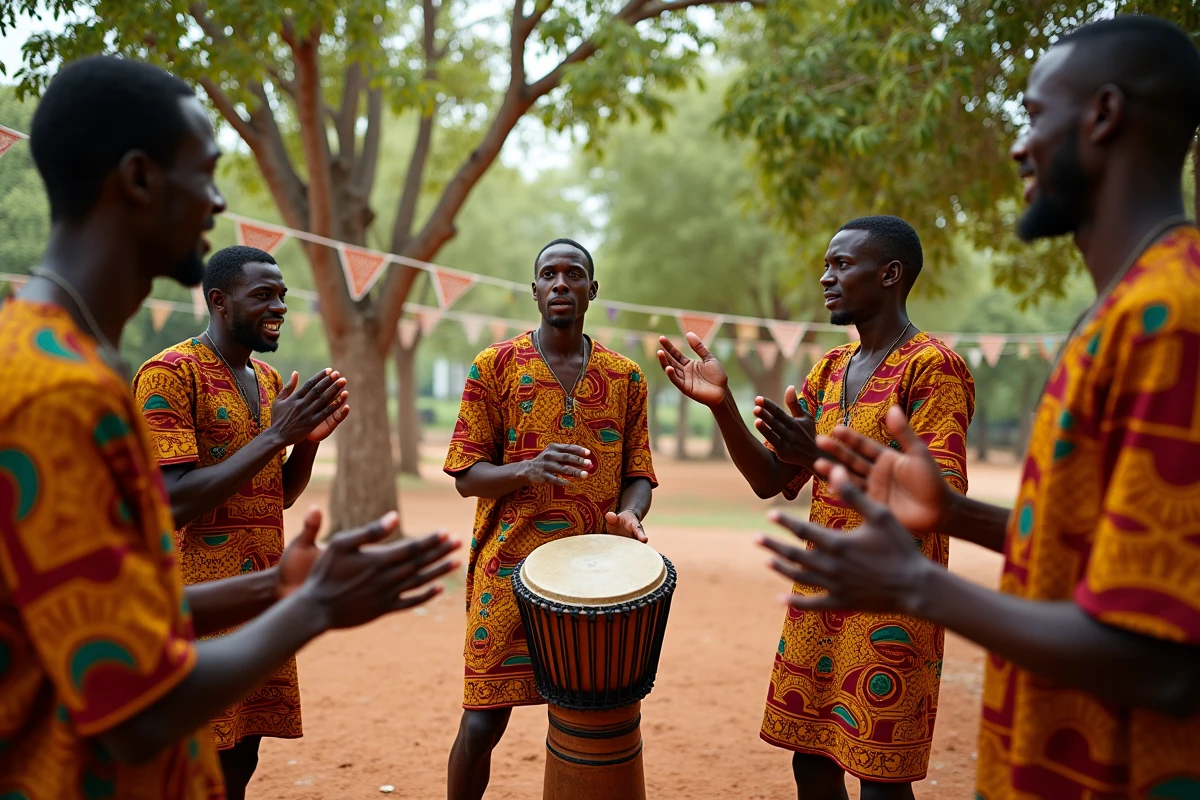
Exchanges between cultures and adaptation of practices
Exchanges between societies accelerate the transformation of customs. A behavior imported from another culture (celebrating Halloween in France, for example) often starts as a custom: a gesture is reproduced without knowing its history.
For an imported practice to become a tradition, the host community must appropriate it and assign it local meaning. Without this appropriation, the practice remains a superficial borrowing, a trend that may disappear in a few years.
This mechanism explains why some recently adopted celebrations struggle to take root. The gesture exists, but the narrative is lacking. And without a narrative, there is no lasting transmission.
The boundary between custom and tradition is never fixed. It shifts as a generation chooses to tell, or forget, the meaning of what it does. A cultural practice lives as long as someone takes the time to explain why it exists, not just to reproduce it.